
Jensen Huang is back, but the questions are bigger than one executive
On 23 November 2026, Nvidia announced that co-founder Jensen Huang had returned as president, chief executive and board director. The company's SEC filing dates the underlying board action to 22 November. This follows his departure earlier in the month amid controversy and scrutiny. The board said it had held discussions with Huang, received input from senior US government officials and concluded that reinstating him posed no national-security risk. Crucially, it also said an independent inquiry into reports of a foreign intelligence effort targeting him would continue. Reinstatement is a corporate decision, not a finding that every allegation or regulatory question has been resolved.
The immediate market reaction was extraordinary: Reuters reported Nvidia shares climbing about a third, while Associated Press reported a broader rally in technology stocks. Such trading demonstrates how strongly investors associate one person with the direction of the artificial-intelligence industry. It does not, on its own, measure new customers, extra computing workloads or additional demand for a cryptocurrency. White Space Crypto's question is whether the episode exposes a dependence on scarce capabilities that create lasting economic value, or simply a powerful story that moves prices before the underlying service changes.
From graphics chips to a platform for AI infrastructure
Huang founded Nvidia in 1993 with Chris Malachowsky and Curtis Priem, originally to advance computer graphics. Its evolution into AI infrastructure was not just a change of marketing language. Nvidia combined accelerators with networking, software tools and integrated systems so developers and operators could train and run increasingly demanding models. The company sells physical and software infrastructure used by cloud platforms and AI developers; its revenue is not a direct measure of how much money an AI application ultimately earns from the end customer.
The difference between hardware demand and sustainable end-user value matters. Nvidia reported fiscal third-quarter 2027 revenue of $115.8 billion for the quarter ended 25 October 2026, up 103% year on year, including $107.6 billion from Data Center. It also reported 74.8% GAAP gross margin and said its Vera Rubin platform had begun shipping. Those are strong, dated company-reported results, not a forecast of perpetual demand. Buyers can expand data centres ahead of actual customer utilisation; some spending depends on financing availability, expectations of future AI usage and infrastructure capacity that may initially sit underused.
The chief executive as a single point of confidence
The board's reversal is a striking governance case. Huang's influence reaches architecture decisions, the developer ecosystem, investors, suppliers and government relationships. After his departure, finance chief Colette Kress served as interim chief executive; after his return she resumed her continuing CFO responsibilities. Nvidia is pursuing an independent investigation, a separate national-security and export-control oversight committee, and a new chief compliance officer. Those structures should be evaluated by how independently they operate and what their inquiries establish, not merely by the names of the committees.
Two claims should be resisted. The first is that Huang personally accounts for all of Nvidia's technology or execution: tens of thousands of employees, customers, contractors and manufacturing partners contribute to its products. The second is that a rising share price settles the company's governance questions. Reuters and AP describe continuing scrutiny and unresolved allegations; they are not verdicts. A business may rely heavily on a founder and still possess substantial institutional strengths. Investors should distinguish confidence in leadership from evidence of internal controls and from customers' long-term willingness to purchase costly computing systems.
Why Nvidia's success is not the same thing as crypto adoption
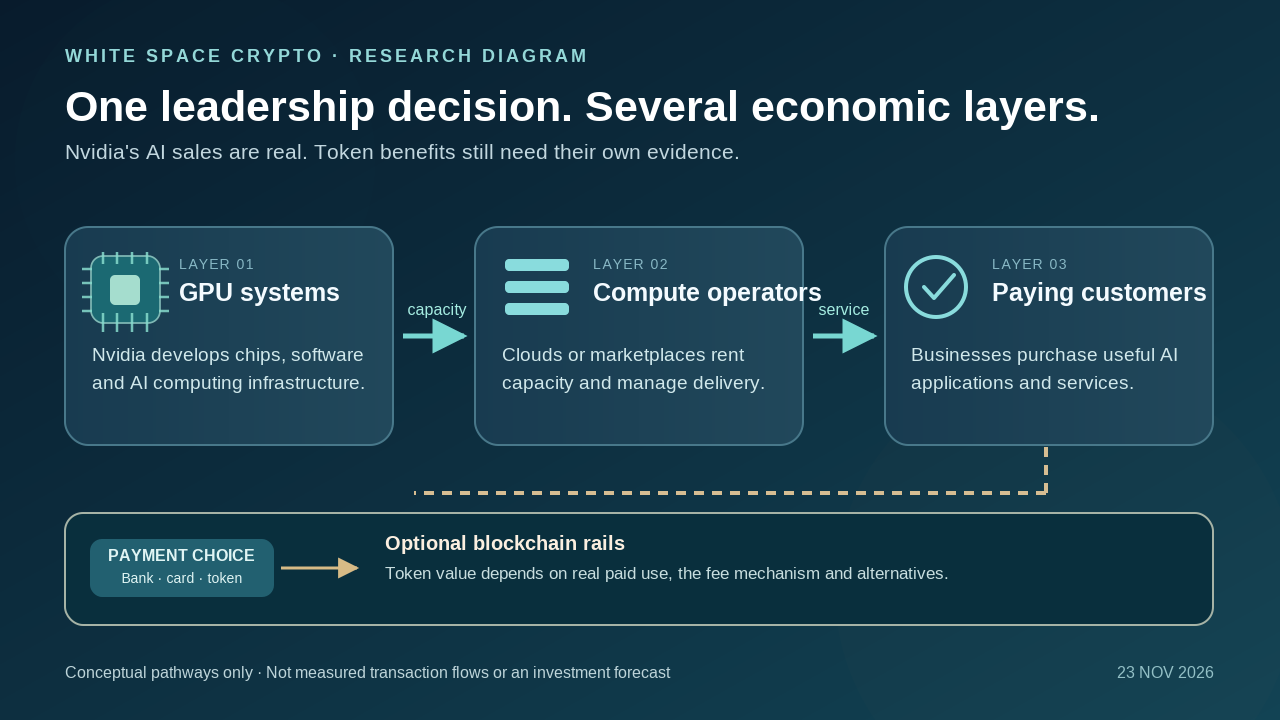
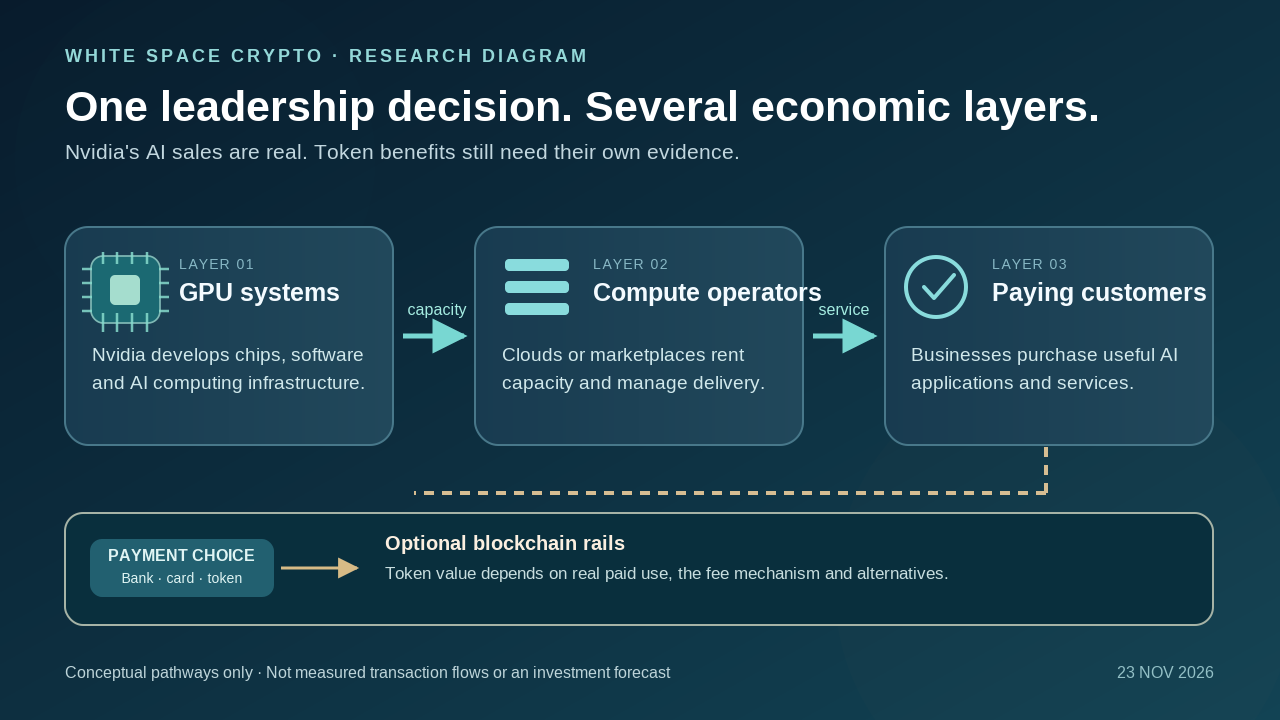
The AI economy contains several layers of possible beneficiaries. At one layer a chip supplier sells processors and complete systems; at another, a cloud operator rents that capacity; at another, developers sell model access or services. A user might then pay for an AI-generated report through a bank transfer, a card, a stablecoin or some other arrangement. There is no necessary cryptocurrency in that chain. Equally, a public blockchain may provide useful settlement or verification without requiring Nvidia hardware. Treating a rally in Nvidia as direct proof that a particular token is newly valuable confuses related markets with identical sources of revenue.
The clearest test is a money trail. Identify a paying AI customer and what service they actually bought. Separate the computing invoice from any blockchain network fee; then ask whether a cryptocurrency is mandatory, whether a provider or application captures the money, and whether any material amount reaches token holders through documented economics. A token can have genuine utility while its owner benefits little from the growth of an adjacent business. It can also benefit from broader AI commerce if repeat external customer demand requires token-denominated settlement or verifiable infrastructure. Both propositions need evidence beyond simultaneous price movements.
Decentralised GPU markets face Nvidia's competitive reality
Decentralised computing networks offer a useful counterexample to a simplistic winner-takes-all story. Akash describes a marketplace linking people needing compute with independent data-centre providers, and documents dollar-linked ACT compute credits alongside the AKT token. Render Network documents a burn-and-mint model in which payments for rendering or AI-related work are translated into credits and token burns, with separate compensation for operators. These mechanisms are meaningful design choices; they do not certify that every registered supplier earns a profit or that demand is growing at the same rate as Nvidia's reported data-centre sales.
Some decentralised suppliers may still buy or rent Nvidia GPUs. Consequently, a stronger Nvidia platform can be an input cost, a product advantage or both. If its chips enable more inexpensive, reliable GPU rental capacity, decentralised marketplaces may attract customers. If large centralised providers offer lower total costs, superior support, better networking or simpler compliance, that same technological progress may erode the marketplace's margin. A serious comparison would hold GPU class, utilisation, availability, network bandwidth, energy, financing, customer support and refunds constant. Token reward emissions are not the same thing as independent revenue from buyers.
A violent market reaction does not establish a durable network effect
Specialist cryptocurrency coverage observed bitcoin rising alongside Nvidia shares and AI-linked equity names on 23 November. The timing is relevant to understanding sentiment, but it is not a controlled experiment. Liquidity, risk appetite, macroeconomic expectations and repositioning after the earlier sell-off all move at once. A temporary correlation cannot identify the channel through which an Nvidia leadership change would raise the future fees of Bitcoin, Ethereum, Render or Akash. Price data also change rapidly: figures reported in the morning should not be presented as a market close.
There is a plausible broader connection: renewed confidence in AI investment could support funding for data centres, workloads and the firms leasing compute. Some miners and hosting companies may have exposure to that infrastructure cycle. Yet a mining company's share price, a cryptocurrency's exchange price and a GPU cloud provider's operating earnings have different drivers. The meaningful research variables are signed customer contracts, actual rented capacity, achieved pricing, operating costs and any enforceable token value-capture mechanism. Without them, Monday's sharp rebound is primarily evidence of markets repricing uncertainty.
The strongest argument in Nvidia's favour—and the serious challenge
Nvidia's durable advantage may extend beyond any one executive: software ecosystems, acceleration libraries, integration with networking hardware, long-standing developer habits and scale can make switching expensive. Its reported margin and product ramp suggest customers still value that bundle. A revived founder may help retain strategic relationships while the organisation works through governance disputes. On the other hand, sophisticated buyers have incentives to develop specialised chips, use rival vendors, optimise models to require less computation, or demand lower prices as supply catches up with need.
The same two-sided mechanism applies to cryptocurrency networks. Smarter AI could create growing demand for neutral computation markets, trustworthy data provenance or small automated cross-border payments. It could also make ordinary cloud procurement, APIs and payment orchestration much cheaper, displacing token-dependent intermediaries. A blockchain moat matters only when a specific customer cannot obtain the required independence, verifiability or censorship resistance from a practical substitute at a similar cost. Technical novelty alone is an insufficient business case for either a processor company or a token.
Five observations that would genuinely change the assessment
First, watch the outcomes of Nvidia's independent investigations, export-control oversight and chief-compliance-officer search, rather than assuming the board's decision closed the matter. Second, compare future Nvidia revenue with deployed capacity, utilisation, customer concentration and gross margins. Third, track whether developers can switch workloads to alternative hardware without sacrificing economically important performance. Fourth, test compute marketplaces against like-for-like cloud prices, reliability, externally paid jobs and subsidy-adjusted provider earnings. Fifth, trace the payment and token supply path wherever an AI application claims to generate cryptocurrency value.
The provisional conclusion is neither that Nvidia's leadership crisis has ruined AI nor that Huang's comeback guarantees a renewed boom. Nvidia is selling valuable infrastructure at enormous scale while navigating governance and national-security challenges. Its influence on the AI economy is real; its influence on the economic value of any given cryptocurrency remains conditional. As AI gets smarter, the networks that matter will be those customers repeatedly pay to use—and whose tokens capture a defensible share of that usefulness after stronger alternatives and existing valuations are taken into account.